Judging Ambulance Stretcher Design by the Transfer Sequence, Not the Feature List
Judging Ambulance Stretcher Design by the Transfer Sequence, Not the Feature List
Blog Article
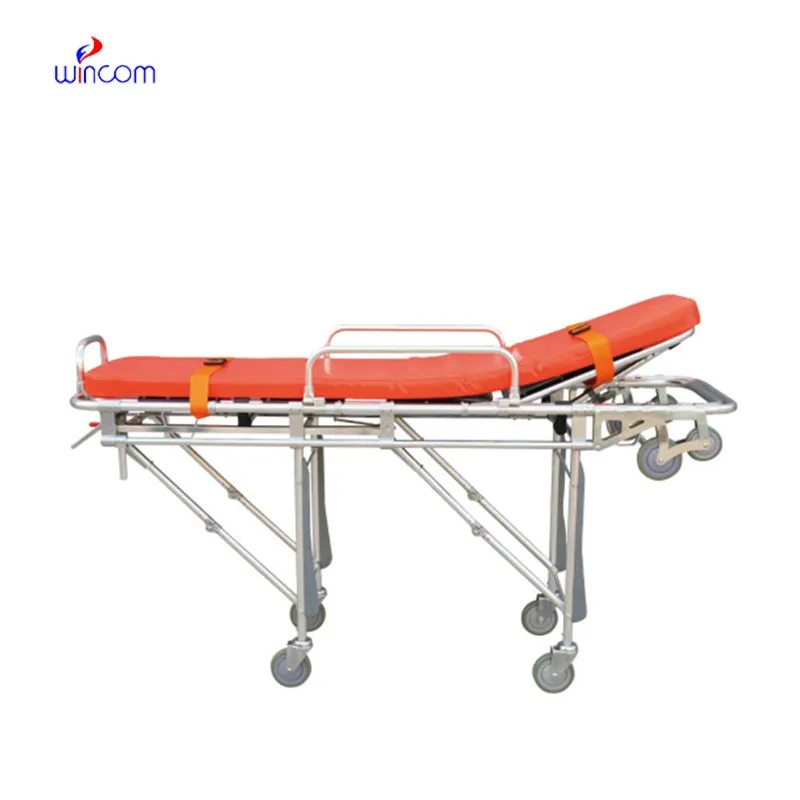
Every stretcher feature that helps one task makes another harder. A heavier frame feels more substantial and increases carrying demand. A powered lift removes vertical lifting and adds charging, service, compatibility, and training requirements. A soft mattress feels better at rest and can complicate cleaning and transfer.
This is why stretcher procurement fails in a consistent way: a fleet buys a feature list, then discovers that the features do not add up inside the vehicle the crew actually drives. The useful innovations are not the ones with the longest specification sheet. They are the ones that reduce unnecessary lifts, make loading and unloading more controlled, keep the patient support surface stable, and let the crew work without fighting the equipment.
## Start with the six tasks inside a single transfer
A patient transfer is not one activity. It is a sequence:
1. Moving the patient from scene to stretcher
2. Securing the patient
3. Negotiating thresholds, ramps, or stairs where applicable
4. Loading into the ambulance
5. Transport
6. Handover
Design decisions should be assessed task by task, because an improvement in one step frequently appears as a cost in another. That is also why "manual versus powered" or "basic versus advanced" are the wrong first questions. The right first question is whether the stretcher, the vehicle interface, the patient population, the cleaning process, and the training plan work together under real call conditions.
## Loading systems carry the most leverage
If design effort is going to be concentrated anywhere, it should be here. Loading systems have the largest potential effect on handling effort, and they are also where incompatible combinations hide.
A stretcher should enter, lock into, and release from the vehicle in a repeatable sequence that crews can perform with a clear view of the latch status. Ambiguity about whether a cot is locked is both a handling problem and a safety problem, and it click here is usually a design problem rather than a crew problem.
Two practical consequences for evaluation:
- **Assess the complete system, including the vehicle mount — not the cot alone.** A cot that locks perfectly on a showroom fixture may not clear or lock correctly against a specific ambulance floor height, restraint arrangement, or clearance envelope.
- **Require a demonstrated loading cycle using the actual ambulance, with the heaviest intended patient configuration.** A demonstration on a supplier's fixture is not evidence of fleet fit, however convincing it looks.
## The small movements are what accumulate
Wheel, handle, and frame details rarely appear on a procurement comparison sheet, yet they determine how a twelve-hour shift feels — and whether crews develop workarounds.
- **Steering control** matters most when positioning in narrow corridors or reversing into a bay
- **Handle geometry** should allow a neutral grip for the crew members who actually use it, including shorter and taller staff
- **Release controls** must be reachable without placing hands near pinch points, evaluated with gloved hands rather than bare ones
- **Frame configuration** should not force a lift that a different layout would avoid
None of these are universal specifications — they are evaluation points. Obtain the operating instructions, inspect the controls physically, and have representative users run the route from vehicle to receiving area before a fleet decision is made.
## Modularity: useful only when the trade-offs are managed
Modularity can genuinely shorten changeover. Removable mattress sections, restraint components, oxygen holders, IV poles, and patient-support accessories let a crew prepare for different patient needs without swapping entire units.
The trade-off is inventory and cleaning control. Every removable item needs a storage location, an inspection routine, and a defined replacement path — otherwise modularity quietly becomes lost components and inconsistent setups. Two rules keep it workable:
- Avoid accessories that are rarely used but stay permanently attached, adding weight and obstructing patient access
- Treat every removable item as an asset with an owner and a check, not as an optional extra
## Patient comfort is a systems property, not a product feature
Comfort during emergency transport is not a cosmetic add-on, but it is also not something a stretcher specification can deliver on its own. Three factors shape it: how well the patient is supported, how predictably the stretcher moves, and how little unnecessary repositioning occurs between scene, vehicle, and handover.
For patients with pain, limited mobility, suspected injury, or post-operative needs, positioning and immobilization practice belongs to the clinical team. Procurement's job is to confirm that the selected stretcher can support the local protocol — not to imply that a product feature produces a clinical outcome.
Practical evaluation points:
- **Support surface stability and restraint layout.** Cushion construction, surface continuity, side access, and the way straps interface with the patient should be assessed against the patient populations most often carried.
- **The mattress trade-off is real.** A very soft surface may be comfortable at rest and difficult to clean or transfer onto; a firmer surface supports handling and may need careful padding decisions.
- **Cleaning compatibility affects both comfort and serviceability.** Request cleaning instructions and confirm compatibility with the disinfectants the service actually uses, because material degradation over time shows up as comfort complaints and premature replacement.
- **No stretcher removes vehicle motion.** Ambulance suspension, driving practice, fixation, and positioning remain part of the equation. Any claim about vibration reduction or ride quality should be verified against an agreed test method on a defined route — recorded by crew members and clinical governance staff — rather than concluded from product appearance.
## A decision matrix for comparing options
The matrix below does not prescribe a configuration. It identifies the questions that must be answered before one is chosen, and the risk created when they are skipped.
| Design area | What to evaluate | Risk if ignored |
| ---------------------- | ----------------------------------------------------------------------------------- | --------------------------------------------------------------------------------- |
| Vehicle interface | Loading sequence, mount compatibility, latch visibility, floor height and clearance | A compatible-looking cot may not lock or clear the specific ambulance correctly |
| Crew handling | Handle positions, control access, wheel behaviour, pinch-point exposure | Extra force or awkward posture slows transfers and complicates training |
| Patient support | Surface continuity, restraint layout, positioning access, cleaning instructions | Comfort and handling needs conflict when the support system is assessed piecemeal |
| Service readiness | Inspection points, manuals, maintenance plan, spare-parts route | One unavailable part or unclear check puts a unit out of service |
| Cleaning and readiness | Removable components, approved agents, turnaround steps | Slow or unreliable decontamination reduces availability, not just hygiene |
## Run a two-phase acceptance evaluation
Use a short, repeatable assessment with the crews who will use the equipment.
**Phase one — configuration and workflow.** Inspect incoming components, labels, manuals, and configuration against the purchase order. Then run the empty stretcher and a safely simulated patient load through the full sequence: deploy, raise or lower if applicable, secure, move through the usual entrance, load, lock, unload, and return to storage. Document where controls are unclear, where a second person is required, and whether the workflow changes for tall, heavy, or mobility-limited patients.
**Phase two — cleaning and readiness.** Have staff remove and replace the mattress or accessories as required, clean surfaces with the service's approved products, inspect straps and locking points, and restore the unit to a ready state. Track time and the number of touchpoints, but do not treat speed alone as success: a design that saves seconds while making inspection unreliable is a poor trade.
Acceptance criteria should cover secure operation, identifiable lock status, crew usability, cleanability, documentation completeness, and a defined route for maintenance and replacement parts.
## Build the purchase around the route, not the catalogue
Stretcher innovation is worth paying for when it makes the transfer sequence more controlled for crews and less disruptive for patients. Start with the route, the vehicle interface, the patient needs, and the local cleaning requirements. Then test the model with representative users and insist on model-specific documentation.
A simple design that fits the fleet, is easy to inspect, and supports consistent handling is frequently a stronger procurement choice than a feature-rich model with weak integration. Where a dedicated ambulance-transport model is being considered, an [ambulance stretcher range organised by vehicle-based workflow](https://www.chinawincom.com/product/Ambulance-Stretcher) is a more useful starting point than a general transport product that has to be adapted afterwards.
## FAQ
**Should we choose a powered or manual stretcher?**
Choose based on the handling demand rather than the category. Assess crew size, typical patient weight and route, vehicle floor height, and shift length. A powered lift reduces vertical lifting but adds charging, service, compatibility, and training requirements — document those before comparing total cost of ownership.
**What evidence should a supplier provide before a fleet decision?**
A demonstrated loading and locking cycle with your ambulance model and floor height, mounting and restraint compatibility data, safe working load, dimensions, materials, certification and labelling information, cleaning guidance, and the spare-parts route.
**How do we evaluate cleaning and turnaround?**
Run the full cleaning cycle with the service's approved agents and time it. Document which components must be removed, how many touchpoints are involved, and whether any surface or strap is incompatible with the disinfectant in use.
**How should acceptance criteria be recorded?**
Define them before the trial: secure operation, visible lock status, crew usability with gloves, cleanability, documentation completeness, and maintenance route. Record observations from representative users rather than assessors alone, and retain the result against the fleet record.
---
**About the author**
*This article was prepared with input from [Wincom Company Ltd.](https://www.chinawincom.com/), a medical and laboratory equipment exporter whose range includes ambulance-transport stretchers and hospital furniture for hospitals, ambulance operators, and distributors. Buyers can [share their ambulance layout, loading arrangement, patient-handling needs, and destination market](https://www.chinawincom.com/contact-us) to receive model-specific configuration evidence.
Report this page